
We offer a guideline-based assessment of attention deficit/hyperactivity disorder (ADHD) and autism spectrum disorder (ASD) in adults, following the current German S3 guidelines — and we carry it out in English where that is your preference: consultation, structured interviews, feedback session and the written report. A frequent reason for referral is long-standing depression, anxiety or chronic exhaustion that has responded only insufficiently to the usual treatments; behind it lie, not infrequently, unrecognised masking and autistic exhaustion.
Fee information in English — download
What the assessment costs, item by item, with the German fee codes (GOÄ) your insurer will ask for. Self-payers and patients with international insurance:
- Fee information · ADHD assessment (PDF, English)
- Fee information · autism spectrum assessment (PDF, English)
- Fee information · combined assessment ADHD + ASD (PDF, English)
German private insurance (PKV) and Beihilfe:
- Fee information · ADHD assessment, private/Beihilfe (PDF, English)
- Fee information · autism spectrum assessment, private/Beihilfe (PDF, English)
- Fee information · combined assessment ADHD + ASD, private/Beihilfe (PDF, English)
The German documents are the authoritative version and are what your insurer will normally want to see: Kosten der Diagnostik. A detailed individual estimate is issued before anything begins.
For patients: how the assessment proceeds
- Detailed clinical and biographical history, where possible including information from a relative or close person
- Structured clinical interviews
- Psychometric testing with established self- and informant-rated instruments
- Careful differential diagnosis (for example distinguishing depression, anxiety and trauma-related disorders)
- A written report with diagnosis and treatment recommendations — also for the doctors and therapists who go on treating you
We do not perform the ADOS-2 in adults; the assessment rests on clinical examination, structured interviews and psychometric testing, as the German adult guideline provides for.
More about how we understand ASD and ADHD — our stance towards diagnosis and the offer of couple therapy where neurodivergence is involved — can be found under “Understanding neurodivergence”.
What “in English” means here
Consultations, interviews and the feedback session are held in English, and the report is written in English. Not every questionnaire exists in a validated English version. Several instruments were developed in English and are used in the original; a few exist only with German norms. Where we have to fall back on a German form, or where norms were established in a German-speaking sample, the report says so — this affects how confidently a score can be interpreted.
With your consent the report goes to your referring practice, and can be issued in German as well if a German-speaking clinician will continue your treatment. We also see people who were assessed as children abroad and need a current report within the German system.
For referring clinicians
We are glad to answer questions from colleagues. The assessment follows the guidelines (see above); findings and the written report with diagnosis, differential diagnosis and treatment recommendations go — with the patient’s consent — to the referring practice promptly.
Treatment following the assessment: after assessment, disorder-specific, manualised treatment — particularly of the associated symptoms — can take place in our private psychiatric practice. As the manuals provide, the course of treatment is measured continuously with scientifically validated instruments.
Treatment manuals in use (a selection):
- Mentalization-Based Treatment (MBT) after Bateman & Fonagy — borderline personality disorder
- Transference-Focused Psychotherapy (TFP) after Clarkin, Yeomans & Kernberg — borderline personality disorder
- Psychodynamic therapy of social phobia (Leichsenring, Beutel, Salzer et al.)
- Psychodynamic therapy of generalised anxiety disorder (Leichsenring & Salzer)
- Panic-Focused Psychodynamic Psychotherapy (PFPP; Subic-Wrana, Milrod & Beutel) — panic disorder
- Long-term analytic psychotherapy of chronic depression (LAC manual; Leuzinger-Bohleber, Fischmann & Beutel)
- Psychodynamic therapy of complex post-traumatic stress disorder (Reddemann & Wöller)
- Psychodynamic-Interpersonal Therapy of somatoform disorders (PISO; Arbeitskreis PISO)
A manual is included in this list only if it has been scientifically validated.
Because our practice holds a statutory psychotherapy licence, we offer the ADHD/ASD assessment as a private medical service under the German fee schedule (GOÄ) — for privately insured patients, those entitled to Beihilfe, and statutorily insured patients as self-payers. Statutorily insured patients can apply to their insurer for reimbursement — application template and procedure; all figures under fees and reimbursement. Appointments via Doctolib or by email.
What you receive at the end
Not a bare yes or no. You receive a written report that also makes your results visible — much as a laboratory report shows internal values. The charts place where you stand in relation to comparison groups. Our aim is to understand your profile of thinking, feeling and behaviour better — and to derive concrete therapeutic starting points from it.
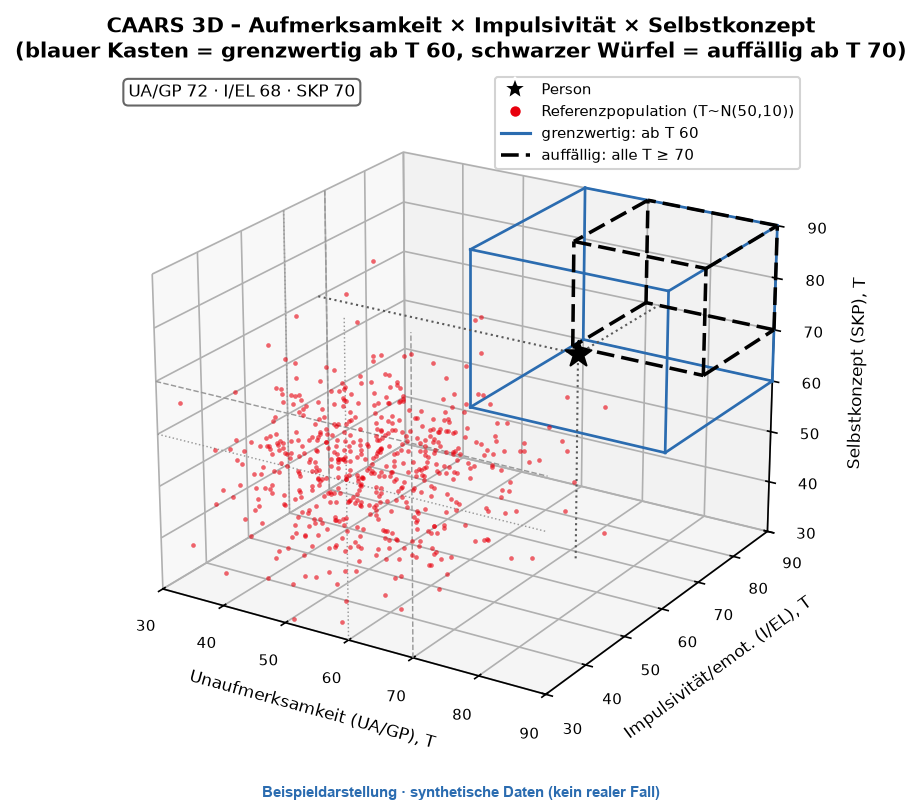
The ADHD profile in space
Your values in relation to the comparison group — where something stands out, visible at a glance.
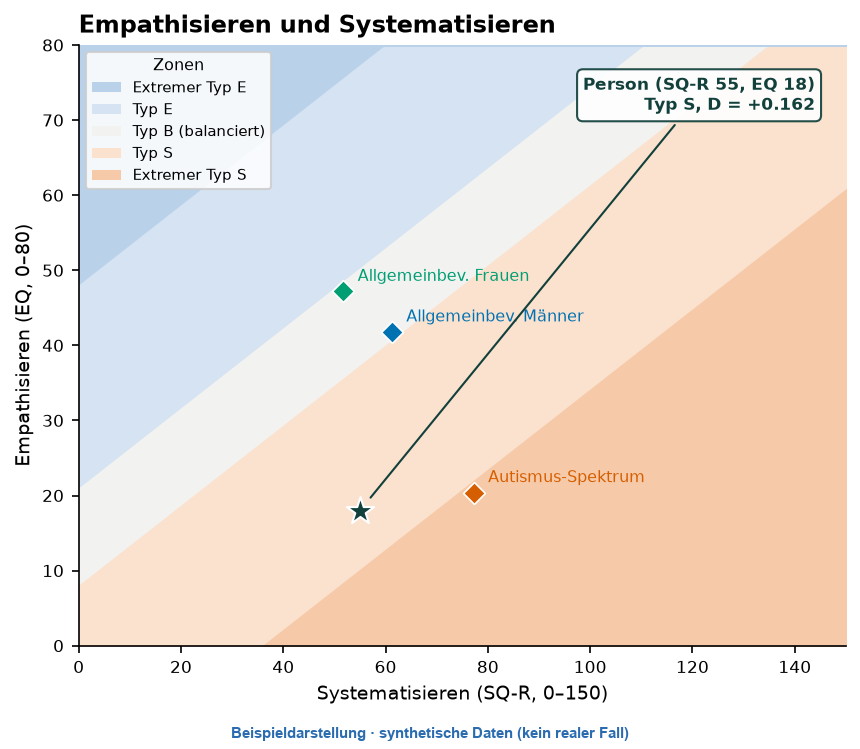
Empathising and systemising
Two cognitive styles in relation to each other — one vivid building block of the ASD findings.
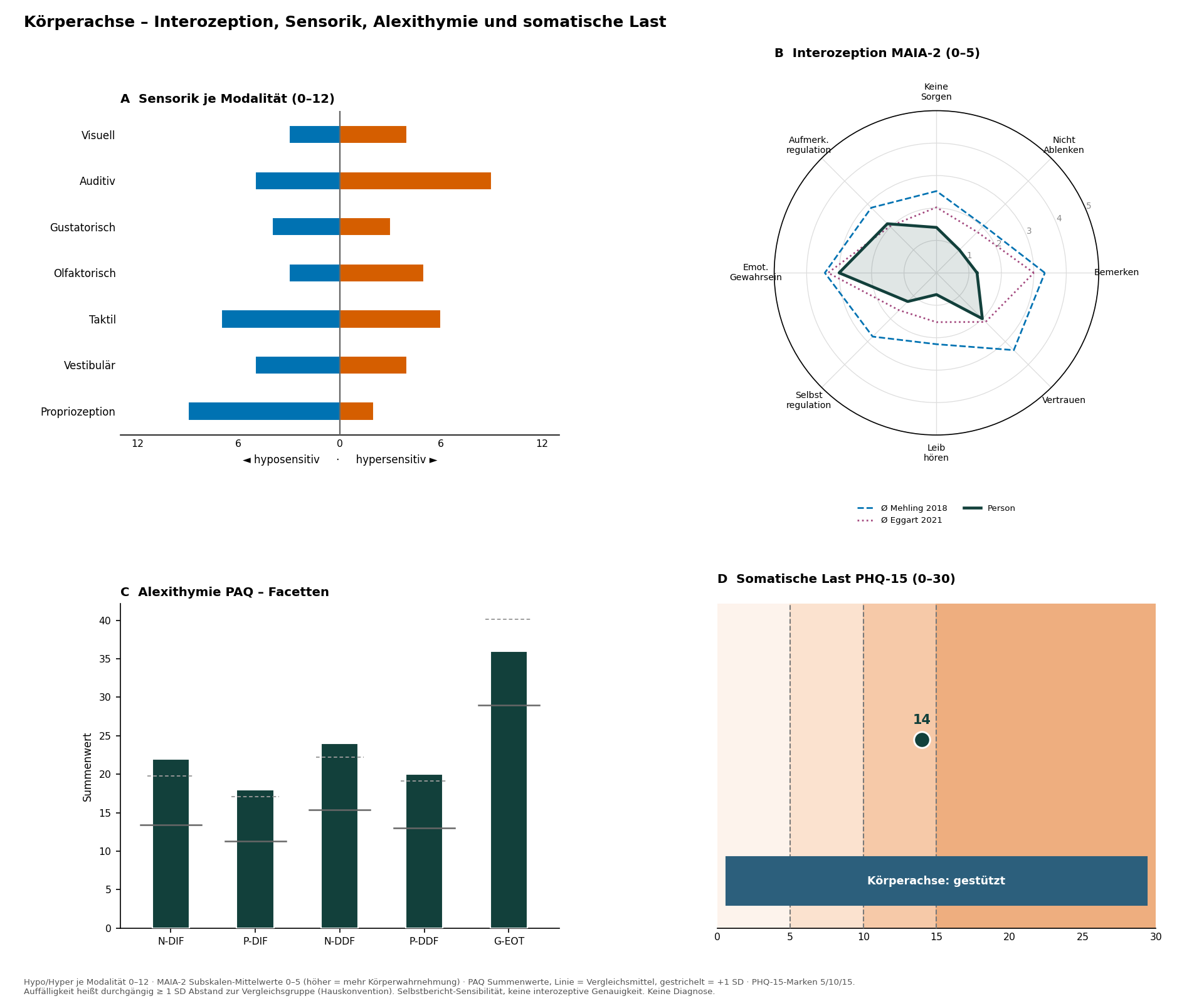
The body profile
Over- and under-sensitivity by sense, body awareness, emotion recognition and physical symptom burden on one sheet — where body and experience belong together.
Synthetic example charts for illustration — our own graphics, not real patient data.
For clinicians
Priorities for treatment planning. On request we evaluate the findings not only diagnostically but derive from them a recommendation of priorities for treatment planning: which themes carry the picture today, which direction of treatment is closer at hand — a focused, practising approach or a structure- and relationship-oriented one — and in what order. Where the findings do not support that, the report says so. The recommendation is decision support; the indication is set by the treating clinician.
Taking stock during ongoing therapy. A psychometric stocktaking can be useful during a treatment already under way — when therapy stalls, when it remains unclear what carries the symptoms today, or when a second perspective on the indication is wanted. We coordinate this with the treating clinician.
Measuring the course. Some of the instruments are sensitive to change and can be repeated after some months. This makes visible whether symptom burden, mentalizing capacity or structural level of functioning have changed — as measurement, not as impression. The report sets out which instruments form the one-off baseline assessment and which are intended as course parameters.
Individual or group setting. An autism-specific group therapy programme is in preparation. On request we set out already now what the findings suggest for or against a group setting, and what adaptations a group needs where neurodivergence is involved. We draw on the current state of research: for autistic adults without intellectual disability, the evaluation of a manualised German group programme has been available since 2026 (FASTER, University of Freiburg, 84 participants). Social responsiveness, self-esteem and depressive symptoms improved to a small-to-moderate degree, quality of life was unchanged — and about a third of those enrolled barely attended the sessions. The authors conclude that careful, autism-specific preparation is needed. This is the purpose of a checklist for the preparatory interview — what speaks for it, what against, what the frame must be able to do. It is not a decision about suitability — admission to a group is always decided in the preparatory interview.
Combining individual and group therapy. The German psychotherapy guideline permits individual and group therapy to be combined — including with the emphasis on the group. Where neurodivergence is involved, a group sensibly does not stand at the beginning of a treatment. First, what individual treatment establishes is needed — a reliable frame, a sustaining relationship and a setting that fits one’s own processing of stimuli. Then the group can become the place where connectedness and separateness can be tried out with others — with a structured introduction beforehand and an accompanying individual session that catches what the group sets in motion. In ADHD, the evidence means that medication belongs in the weighing as well — how we put that question and what the evidence supports is set out under Medication: what we know and what we do not. What makes sense in the individual case we discuss in the feedback session.
Onward referral. Where a treatment need emerges that we do not cover ourselves, we name it and help with the search for a suitable method or setting.
All recommendations are decision support on the basis of the test findings — not a prescription of treatment. The form of therapy and the setting are decided by the patient and the treating clinician together. On the group study: Schweizer et al. (2026), Frontiers in Psychiatry, doi 10.3389/fpsyt.2026.1863942 — a naturalistic single-arm study without a control group; the results do not establish cause and effect.
Fees and reimbursement
The aim is an understanding rather than a label — a report you can read and place, and from which concrete next steps follow. The scope of the assessment follows from that: as thorough as the question requires, and no more.
Appointments are invoiced under the German medical fee schedule for physicians (GOÄ). For self-payers, assessing one question — ADHD or ASD — typically comes to €420.11. Where both questions are brought together in a single assessment it is €495.86, because screening, first consultation, structured interview, feedback session and written report then arise only once.
In-depth differential modules — a collateral history with a relative, additional structured interviews, further test batteries on personality, structure, anxiety or body awareness, or a trauma module with a detailed history — are recommended only where screening or findings give a concrete reason, and always after discussion with you; depending on scope they range from €67.04 to €142.48. Only services actually provided are invoiced; modules not needed simply fall away.
Who bears the cost?
Privately insured patients and those entitled to Beihilfe: private tariffs and Beihilfe leave more room in how the assessment is designed — and we use that room for more service: the first consultation and the feedback session take place as specialist consultations, with time for your questions, for placing the findings together and for what they mean for daily life, relationships and treatment; in the structured-interview session the psychiatric findings are also recorded separately. Assessing one question then comes to €619.75, both questions together to €695.50. Self-payers can of course book these services as well; the total rises accordingly. A guideline-compliant, thorough differential assessment under GOÄ is usually eligible for reimbursement. Your particular tariff decides — please clarify cover with your insurer or Beihilfe office in advance. We will gladly provide the itemised estimate with the fee codes beforehand for that purpose.
Statutorily insured patients: because our practice is licensed primarily as a statutory psychotherapy practice, this specialist psychiatric assessment cannot be billed via the insurance card. You may take up the assessment as a self-payer, or apply to your insurer for reimbursement beforehand.
Reimbursement for statutorily insured patients
If a German statutory health insurer cannot provide a necessary service in time through doctors within the statutory system, it must reimburse the cost of a service obtained privately (§ 13 (3) SGB V). Whether that applies is decided by the insurer case by case. There is a template for the application that works for every insurer. The application has to be in German; the form is German with an English translation beneath each passage.
- Application template with English guidance and enquiry log (fillable PDF)
- Application template as a Word file (for editing)
- Rein deutsche Fassung (PDF) · Word
- Ask for appointments within the statutory system — psychiatric practices, hospital outpatient departments and specialist adult clinics, and the appointment service on 116 117. Record every enquiry with date and outcome in the log.
- Have the need confirmed — a referral or short note from your GP or treating psychotherapist.
- Submit the application with the appropriate fee information (self-payer version; the German PDF is authoritative), the log and any medical letters — in a way you can prove, for instance by registered post.
- Wait for the decision. The insurer must decide within three weeks, or five weeks if its medical service is involved (§ 13 (3a) SGB V). Please clarify the question of costs with your insurer before booking an appointment.
The template is a guide to completing the application, not legal advice. If the application is refused, an objection (Widerspruch) is possible within one month; free advice in German is available from the Unabhängige Patientenberatung Deutschland on 0800 011 77 22.
International insurance. You settle our invoice and may submit it to your insurer. Whether and how much is reimbursed depends entirely on your policy — reimbursement cannot be promised.
The detailed figures
The full breakdown with all fee codes, in English:
- Fee information · ADHD assessment (PDF, English)
- Fee information · autism spectrum assessment (PDF, English)
- Fee information · combined assessment ADHD + ASD (PDF, English)
For privately insured patients and those entitled to Beihilfe:
- Fee information · ADHD assessment, private/Beihilfe (PDF, English)
- Fee information · autism spectrum assessment, private/Beihilfe (PDF, English)
- Fee information · combined assessment ADHD + ASD, private/Beihilfe (PDF, English)
The German versions are authoritative: Kosteninformationen (deutsch).
A clinical assessment. Our examination serves clinical classification, treatment planning and communication with the doctors and therapists who treat you alongside us or after us. You receive a detailed written report which — with your consent — also goes to the referring or continuing practice.
Where further support is at stake. Where a supportive measure is being sought — medical or vocational rehabilitation, assistance towards participation and inclusion (Eingliederungshilfe, Leistungen zur Teilhabe), or reasonable adjustments in study or at work — the report can, on request, also describe your level of functioning and capacity, where the question calls for it with a standardised instrument developed for that purpose (Mini-ICF-APP). Do talk to us; we will tell you what we can contribute.
What we do not offer are expert opinions in contested proceedings. We examine and treat clinically — entitlements are decided by the respective body itself.
As of September 2026. This overview is for orientation and is not a contract; the fee agreement and the services actually provided are what count. Please cancel agreed appointments at least 24 hours in advance; for later cancellation a reservation fee of €60.00 is charged.
Who this is for — and who it is not for
The assessment is for privately insured patients, those entitled to Beihilfe, and self-payers, including patients with international insurance. Because the practice holds a statutory psychotherapy licence, this specialist assessment cannot be billed to German statutory health insurance; statutorily insured patients can apply for reimbursement.
If an acute crisis is the reason you are getting in touch — acute suicidal thoughts, an acute psychotic or manic episode — an assessment is not the right first step. In Germany, emergency help is available around the clock on 112, and the telephone counselling service Telefonseelsorge can be reached free of charge on 0800 111 0 111 and 0800 111 0 222.
Getting an appointment
Appointments for private consultations and for the assessment are best arranged via Doctolib or by email. Please mention that you would like the assessment in English, so that we can plan the questionnaire set accordingly.
Praxis für Psychotherapie am Pottkamp
Dr. med. Stephan-Sebastian Scherer — Consultant Psychiatrist and Psychotherapist
Pottkamp 23 · 48149 Münster · Germany
Phone +49 251 97446348 ·
scherer@psychotherapie-am-pottkamp.de
Frequently asked questions about ADHD and ASD assessment
How does an ADHD assessment for adults in Münster proceed?
The assessment comprises a detailed clinical and biographical history, where possible including information from a relative or close person, structured clinical interviews and psychometric testing with established self- and informant-rated instruments. At the end stands a written report with diagnosis, differential diagnosis and treatment recommendations.
Do you perform the ADOS-2 in adults?
No. We do not perform the ADOS-2 in adults. The assessment rests on clinical examination, structured interviews and psychometric testing, as the German adult guideline provides for.
Can the assessment be conducted entirely in English?
Yes. Consultation, structured interviews, feedback session and the written report can be conducted in English. The limitation is the questionnaires: not all of them exist in a validated English version. Where a German form has to be used, or where the norms come from a German-speaking sample, the report says so and takes it into account in the interpretation.
Who is the assessment for?
It is for privately insured patients and those entitled to Beihilfe, as well as statutorily insured patients and people with international insurance as self-payers. Because the practice holds a statutory psychotherapy licence, the assessment cannot be billed to German statutory health insurance. You receive an itemised cost estimate with the fee codes and time allocations in advance — also for a reimbursement application.
Will German statutory health insurance pay?
Not automatically. If you cannot obtain an appointment for the assessment from doctors within the statutory system in reasonable time, you can apply to your insurer for reimbursement under § 13 (3) SGB V — please do so before booking an appointment. A template for every insurer, with English guidance and a log for your appointment enquiries, is in the section “Reimbursement for statutorily insured patients”. Whether costs are reimbursed is decided by the insurer case by case.
How are the fees regulated?
Invoicing follows the German medical fee schedule (GOÄ); before we begin we conclude a written fee agreement and you receive an itemised cost estimate with the fee codes and time allocations. The scope follows the question — in-depth modules are recommended only where screening or findings give a concrete reason, and always after discussion; only what is actually provided is invoiced. The current figures are in the section “Fees and reimbursement” and in the fee information PDFs above.
When is an assessment sensible?
A frequent reason is long-standing depression, anxiety or chronic exhaustion that has responded only insufficiently to the usual treatments. Behind it lie, not infrequently, unrecognised masking and autistic exhaustion.
What happens after the assessment?
Afterwards, disorder-specific, manualised treatment — particularly of the associated symptoms — can take place in the private psychiatric practice. The course is measured continuously with validated instruments. Findings and report go — with consent — to the referring practice promptly.
Do you write reports for rehabilitation or disability-support applications?
Yes. Where a supportive measure is being sought — medical or vocational rehabilitation, assistance towards participation and inclusion (Eingliederungshilfe, Leistungen zur Teilhabe), or reasonable adjustments in study or at work — the report can, on request, also describe your level of functioning and capacity, where the question calls for it with a standardised instrument developed for that purpose (Mini-ICF-APP). Please tell us beforehand, so that we can include the question in the assessment. What we cannot offer are expert opinions in contested proceedings; entitlements are decided by the respective body itself.
How do I get an appointment?
Appointments for private treatment and for the assessment are best arranged via Doctolib or by email. For the psychotherapeutic consultation you can reach us by telephone on +49 251 97 44 63 48.